.jpg)
Tuesday, May 13, 2014

Monday, May 12, 2014
Finally some Shorebirds!
Farming and birding occasionally go together, like on a Sunday when we have to drive to Regina to get parts that aren't available anywhere closer.
We took the long, long way home and drive down backroads we'd never seen before, and most of which ended in dead ends and involved backtracking. However it seemed that every time we backtracked we were able to see either different birds, or a better look at a previous bird. Considering the mobility of birds, I don't usually mind retracing my steps at any time.
.jpg) A Solitary Sandpiper. A lifer, but one we almost certainly have seen before, just didn't recognize. I am hoping now that I have become acquainted with his spots, we will recognize him immediately the next time we meet.
A Solitary Sandpiper. A lifer, but one we almost certainly have seen before, just didn't recognize. I am hoping now that I have become acquainted with his spots, we will recognize him immediately the next time we meet.
The bird below is probably a Lesser Yellowlegs. His legs are not visible here, but his top parts match the other photos I have of Lesser Yellowlegs.
.jpg) We saw a lot of Red-winged Blackbirds, but just a few Yellow-headed, including this female.
We saw a lot of Red-winged Blackbirds, but just a few Yellow-headed, including this female.
.jpg) She was walking along this slough edge, intently checking out the straw. Not sure if she was looking for the perfect nesting spot, or just looking for lunch.
She was walking along this slough edge, intently checking out the straw. Not sure if she was looking for the perfect nesting spot, or just looking for lunch.
Our other lifer for the day was the Palm Warbler. We saw 2 or 3 of these. Through the binoculars they were truly beautiful. Considering how many warblers migrate through Southern Saskatchewan, I am always disappointed in how few I see so this was another memorable moment for me. The best of the day, I can say, although I admit this was not my best photo of the day.

We took the long, long way home and drive down backroads we'd never seen before, and most of which ended in dead ends and involved backtracking. However it seemed that every time we backtracked we were able to see either different birds, or a better look at a previous bird. Considering the mobility of birds, I don't usually mind retracing my steps at any time.
The bird below is probably a Lesser Yellowlegs. His legs are not visible here, but his top parts match the other photos I have of Lesser Yellowlegs.
Our other lifer for the day was the Palm Warbler. We saw 2 or 3 of these. Through the binoculars they were truly beautiful. Considering how many warblers migrate through Southern Saskatchewan, I am always disappointed in how few I see so this was another memorable moment for me. The best of the day, I can say, although I admit this was not my best photo of the day.
Sunday, April 27, 2014
Birding in the Rain
I don't recall doing any rainy day birding before, but today we had a reason to drive near Saskatoon so we combined it with a search for birds. Specifically, shorebirds. I'd heard of shorebird sightings so expected we would see some. And we did. Avocets and a killdeer. There were a few others that we were unable to ID because they were a blur as we drove by or simply too far away when we stopped, but no where near the number I expected to see. It was still a good birding day, however.
Ever seen round swallows? This is what Tree Swallows and Barn Swallows look like when it is cold. They are probably wishing they'd stayed south a little longer.
.jpg)
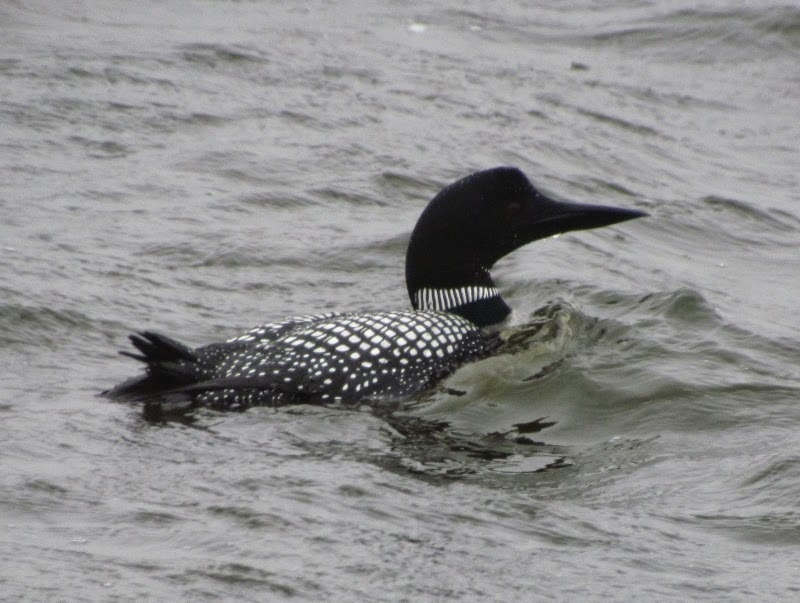
.jpg) We saw Common Loons,
We saw Common Loons,
 pink-tinged Franklin's Gulls,
 and headless Double-crested Cormorants.
.jpg) More than 40 species altogether, not counting the mystery hawks.
More than 40 species altogether, not counting the mystery hawks.
My last bird is one of the quintessential Saskatchewan birds. The Western Meadowlark.
.jpg)
Ever seen round swallows? This is what Tree Swallows and Barn Swallows look like when it is cold. They are probably wishing they'd stayed south a little longer.
My last bird is one of the quintessential Saskatchewan birds. The Western Meadowlark.
The sparrows are coming! The sparrows are coming!
We are a small oasis of trees in the middle of a lot of grainland so it is always a concern that the birds will simply fly right over top of us and never drop by even for a visit. But inevitably some of them do. And this week it was the White-throated and White-crowned Sparrows. And they brought their songs with them. (This is the White-crowned here, looking quite cute, I think.)
.jpg) It is still unseasonably cold here, and rainy, which despite the proverb (April showers bring...) is very rare for us. Normally we are seeding into dry ground and fervently praying for rain to make the crops grow. This winter was cold and lengthy, but the snow melted quickly which allowed most of the moisture to run off. Now, though it means we have cold, cloudy days, at least the rain will be sinking the moisture into the soil where we need it. And, we hope, in a couple of days it will warm up and even more spring birds will drop in and check us out.
It is still unseasonably cold here, and rainy, which despite the proverb (April showers bring...) is very rare for us. Normally we are seeding into dry ground and fervently praying for rain to make the crops grow. This winter was cold and lengthy, but the snow melted quickly which allowed most of the moisture to run off. Now, though it means we have cold, cloudy days, at least the rain will be sinking the moisture into the soil where we need it. And, we hope, in a couple of days it will warm up and even more spring birds will drop in and check us out.
Tuesday, April 15, 2014
Spring!
Yes, I know we are still breaking records for cold weather. There is still snow in places, not so much where we are but that is not unusual, even in the middle of winter. On a walk yesterday we did not see any crocuses, but it is still spring.
Proof:
A pair of Canada Geese is checking out the dam. The frozen dam, but they are apparently optimists.
.jpg) Snow Geese are flying overhead
Snow Geese are flying overhead
.jpg) and landing on a nearby slough in numbers not normally seen in our area in the spring.
and landing on a nearby slough in numbers not normally seen in our area in the spring.
.jpg) Lots of white and blue geese here. I saw one Northern Pintail along the edge of the slough, but didn't particularly notice any Canadas with them.
Lots of white and blue geese here. I saw one Northern Pintail along the edge of the slough, but didn't particularly notice any Canadas with them.
Proof:
A pair of Canada Geese is checking out the dam. The frozen dam, but they are apparently optimists.
Friday, March 14, 2014
More from Mexico
We got a lot of lifers on our recent trip, Ray is estimating 50 but I haven't actually tabulated yet. The tricky part is that we only have photos of a few. Many were glimpses through foliage, or, worse yet, came during the time my camera battery had died and I had left the spare at the hotel. (Talk about being disgusted with one's self!)
Here are a few more of the new ones for which I do have photos. Some of my photos, the ones I'm not posting, ID the bird, but are fuzzy or grainy so have no aesthetic appeal.
My goal was to see colourful birds, trogons and parrots being at the top of that list. Here is the only trogon I was able to photograph. This Elegant Trogon was directly over our heads, he (she?) sat there for a long time calling something that was somewhere between a cough and the caw of a crow.
.jpg) Next is a San Blas Jay, a bird that does not live at San Blas. Something to do with two jays looking similar, and the people naming them thinking they were one. When they separated them out, here is the one that kept the name it didn't deserve. This photo was taken at the Botanical Gardens in Puerto Vallarta where they attract birds with feeders, I think this guy is eating papaya, but we also saw them in a more natural habitat, but further away from my camera.
Next is a San Blas Jay, a bird that does not live at San Blas. Something to do with two jays looking similar, and the people naming them thinking they were one. When they separated them out, here is the one that kept the name it didn't deserve. This photo was taken at the Botanical Gardens in Puerto Vallarta where they attract birds with feeders, I think this guy is eating papaya, but we also saw them in a more natural habitat, but further away from my camera.
.jpg) The new bird we saw the most often, almost everywhere we went, was the Yellow-winged Cacique. It is pronounced Ka SEEK. The Spanish speakers pronounce the final e turning it into Ka SEEK eh.
The new bird we saw the most often, almost everywhere we went, was the Yellow-winged Cacique. It is pronounced Ka SEEK. The Spanish speakers pronounce the final e turning it into Ka SEEK eh.
 Not colourful at all, but this pretty little bird looks like he should be migrating to Saskatchewan every spring. The White-throated Thrush. Formerly called a robin, till the world birders decided that New World thrushes can only be called robins if they have red on their fronts, otherwise they are thrushes. Apparently birders in the Old World rather resent our using the word robin to describe a bird not related to their robin. Having seen their very pretty little robin, I can almost understand. However, the New World birders won a partial victory by explaining that the name robin is so culturally accepted here that changing our robin to a thrush would never succeed. No one would use the new name.
.jpg) Following this same decision, this Rufous-backed Robin gets to keep his name. You will have a hard time seeing the red chest in this photo. Turns out, the Rufous-backed Robin became a bit of a Nemesis bird to me. He just would not let me take a good photo, no matter where I saw him. This was the best. From the front he resembles the American Robin with the striped throat of the thrush above.
Following this same decision, this Rufous-backed Robin gets to keep his name. You will have a hard time seeing the red chest in this photo. Turns out, the Rufous-backed Robin became a bit of a Nemesis bird to me. He just would not let me take a good photo, no matter where I saw him. This was the best. From the front he resembles the American Robin with the striped throat of the thrush above.
.jpg) Another bird we saw several times. The Stripe-headed Sparrow.
Another bird we saw several times. The Stripe-headed Sparrow.
.jpg) While the above photos were taken in the general area of Puerto Vallarta, the last three photos are from San Blas.
While the above photos were taken in the general area of Puerto Vallarta, the last three photos are from San Blas.
Shore birds are often easier to photograph. They are more inclined to stand around than perching birds. We didn't see as many new shorebirds because many of the birds here were the same as those we had in Mazatlán. Two I had been hoping for, and saw, were
the Boat-billed Heron
.jpg) and the Bare-throated Tiger Heron.
and the Bare-throated Tiger Heron.
.jpg) The last photo is of a Spotted Rail, reportedly a shy bird who surprised our guide by posing for several minutes. It was late in the afternoon (6:21 local time) and the mangroves were hiding the sun. I changed the camera to a low light setting and was impressed with what it could do.
The last photo is of a Spotted Rail, reportedly a shy bird who surprised our guide by posing for several minutes. It was late in the afternoon (6:21 local time) and the mangroves were hiding the sun. I changed the camera to a low light setting and was impressed with what it could do.
.jpg)
Here are a few more of the new ones for which I do have photos. Some of my photos, the ones I'm not posting, ID the bird, but are fuzzy or grainy so have no aesthetic appeal.
My goal was to see colourful birds, trogons and parrots being at the top of that list. Here is the only trogon I was able to photograph. This Elegant Trogon was directly over our heads, he (she?) sat there for a long time calling something that was somewhere between a cough and the caw of a crow.
Shore birds are often easier to photograph. They are more inclined to stand around than perching birds. We didn't see as many new shorebirds because many of the birds here were the same as those we had in Mazatlán. Two I had been hoping for, and saw, were
the Boat-billed Heron
Wednesday, March 12, 2014
Birding San Blas
Having visited Mazatlan
several times, this year Ray and I decided to go to the place we had heard so
much about. The place in Mexico
where every birder needs to go. San
Blas.
.jpg)
White Ibis a block from our hotel.
I knew about San Blas mostly from reading a few blog posts. Unfortunately they were not recent or did not
explain how the birders got there. I’m
writing this so others will benefit from what we
learned. (Saskatchewan birds will return to this blog soon. I saw 2 Canada Geese today and flocks of Horned Larks.)
.jpg)
View from the old fort overlooking the city.
San Blas is a smallish city about three hours north of Puerto
Vallarta along the coast. We flew into Puerto
Vallarta in the morning of February 24, 2014. To avoid the expensive airport taxis, we
walked out of the airport, turned left twice and walked up a ramp and across
the busy Highway 200. Waiting at the
bottom of the ramp on the other side was a man saying “Taxi?” He had a clean, white taxi standing there so I
stumbled through “¿Cuánto a la Central Camionera?” and
he immediately turned the conversation into English and said 70 pesos. We said si, or maybe okay, and climbed into
the car. Minutes later he was offering
to drive us all the way to San Blas. Now, we had already looked into the price
of a taxi to San Blas, and our source, Superior Tours in Puerto
Vallarta, had quoted us $220 USD. Not interested. We later learned that it is possible to get a
taxi from San Blas to pick people up at the airport for $100 to $150 but I
think you would need a contact in San Blas to make that arrangement.

Inside the bus terminal in Puerto Vallarta.
Inside the bus terminal, we lined up at the Pacifico Futura
counter. When our turn came, I stumbled through more of my pre-planned Spanish.
188 pesos per person. (Less than $20
Cdn) Next bus: 12:30 p.m. Less than 2 hours. We could easily people-watch that long. We had been told the last bus of the day to San Blas was at 3,
but had no idea when others were, so were pleased to know we would arrive in
day light. There was a snack booth and a washroom (5 pesos plus tip for the
attendant) and at 12:20 we exited
through the back door and looked for our bus. It was a Norte de Sonora second
class bus, no washrooms but excellent air conditioning. (Bring a sweater.) We had been told that Mexican bus drivers
gave people receipts for their luggage, but in our three bus rides on the
Nayarit coast this did not happen even once. And no one stole our luggage.

A group of students who'd ridden the bus for a few miles.
The driver had little regard for the speed limit, though a
lot of respect for the topes (speed bumps) and got us into San Blas just before
4, (3 with the time change) after stopping several times to pick up or put down people. There were taxis
at the bus stop which we could have taken, but we thought we knew the way to
our hotel from the maps we’d studied so decided to walk. It probably would have
worked, too, if the bus terminal wasn’t closed because of a strike and they were making do with a
kiosk next to the taxi stand. As it was,
we saw some of San Blas as we pulled our luggage behind us, and were able to
use a few more carefully chosen Spanish words asking directions, and found our
way to the Hacienda Flamingos (an interesting name, given that there are no
flamingos in this birdy town.)
.jpg)
Magnificent Frigatebirds hoping for some fish scraps.
During our time in San Blas, we relied on Mark Stackhouse to
get us to where the birds were, and to find the birds for us when we got
there. I understand there are several
guides based in San Blas but we chose Mark because I could find his email
address (westwings@sisna.com) . He took us, along with Gale and Frank from New
York City, and gave us two memorable days. And lots of new birds.
.jpg)
Orange-fronted Parakeet
The first day we did some wetlands close to San Blas in the morning, watched the birds at Mark's feeder over lunch, then after a short siesta break, took a boat out onto the ocean to see the Blue-footed Boobies.
+(640x480).jpg)
The second day we went into the mountains in the morning, then took the incredible boat journey through the estuaries to La Tovara springs in the late afternoon. When Ray and I are asked what was our most memorable part of the two weeks in Mexico, that boat ride is what we both say. It was great. Even if I didn't get a decent photo of a Green Kingfisher. The boat was owned and operated by another local birder whose name I'd come across in my research, Chencho. He was amazing at navigating the boat through the estuary in the dark.
.jpg)
Limpkin
We are very grateful to Mark Stackhouse for showing us the birds of San Blas. It was the best kind of holiday. The kind where you get up early and see great new birds!
.jpg)
Masked Tityra
.jpg)
Golden-cheeked Woodpecker
Subscribe to:
Posts (Atom)